


April was loud. A small black-and-white print in a Milanese living room I could not stop thinking about. A book about finitude on the studio worktable. An archive of fashion shoots no one was allowed to direct. A podcast about a man trying to put a plant on Mars. Four people. Four disciplines. Four scales of ambition. None of them are connected. Except they are.
Roberto Salbitani. The world as co-author
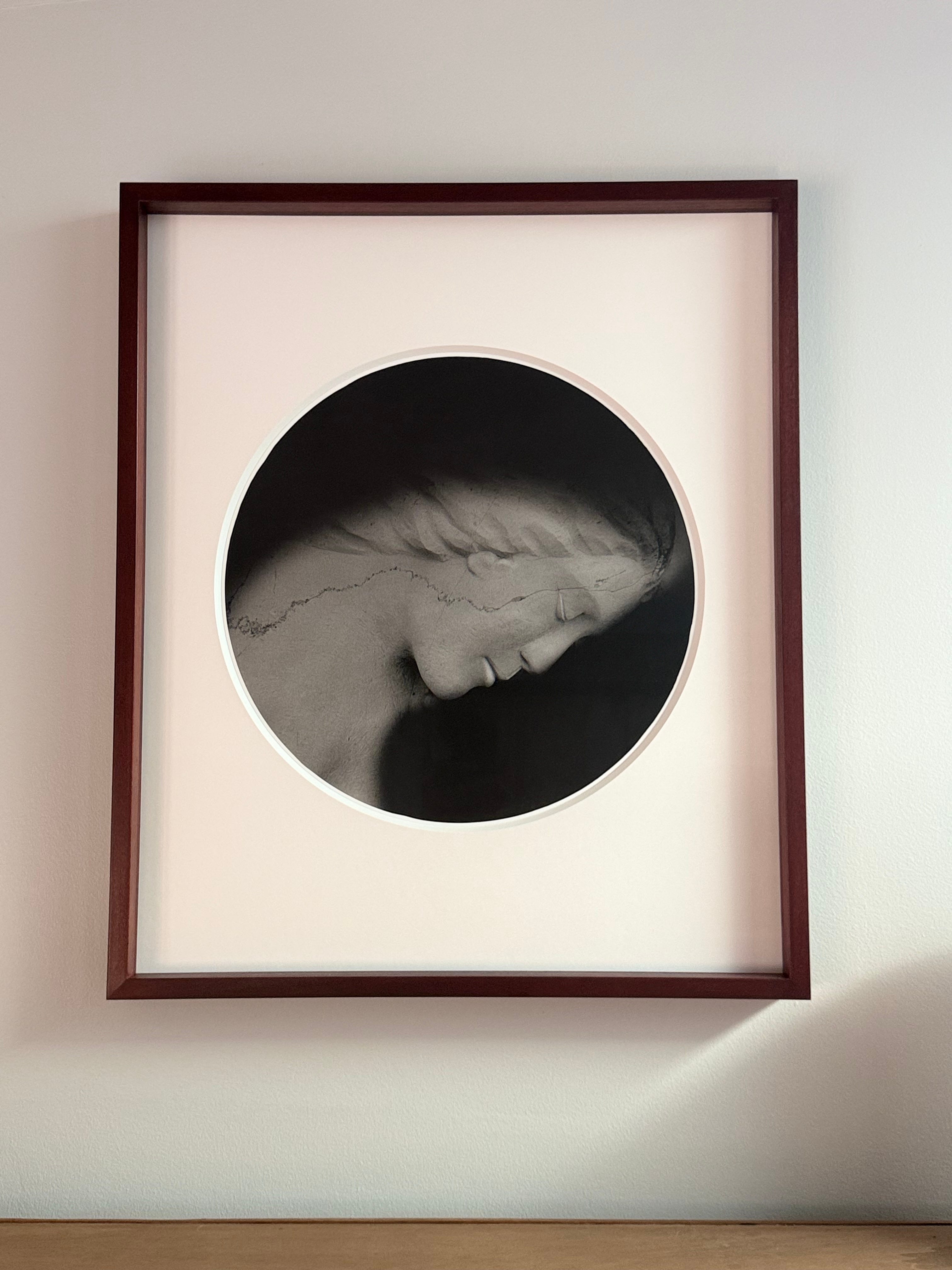
In March I went back to see Ettore Molinario at his Casa Museo in Milan. I wrote about that first visit last year, about how his collection holds work the market has mostly forgotten, and the way he talks about each photograph as if it were someone he personally knows. This time, one image stopped me cold.
It was a small black-and-white print by Roberto Salbitani. I do not know the title. I have not been able to find it online. But I have not stopped thinking about it.
Salbitani was born in Padua in 1945 and has lived in Rome for decades. He shoots black and white on film, develops his own negatives, prints his own work. The tones are dense, almost tarry. The blacks have weight. He has been doing this for over fifty years, mostly outside the gallery system, mostly on his own terms.
His best-known series is La città invasa (1972 to 1984): Italian cities photographed at the moment advertising, signage, and surveillance began to overrun public space. Other series, Il viaggiatore parallelo, Venezia. Circumnavigazioni e derive, Lune, Lettera dall’ex manicomio S. Giovanni di Trieste, extend the same instinct. A slow, attentive way of looking at how landscape and memory press against each other.
What stays with me is something he said in an interview last summer: “I consider the world the co-author of my images.” Not subject. Co-author. The world is doing half the work, and the photographer’s job is to listen carefully enough to recognise its half of the sentence.
That is a position that demands patience. It refuses the idea of the photographer as author-in-charge. And it sits close to what I wrote last month about niwaki and Sella’s archive. The idea that the work is already there, and the practice is in showing up to meet it.
Oliver Burkeman. Embrace your limitations
I read a lot about productivity. Not the LinkedIn version. The real version, the kind that asks what a finite life is actually for. As an artist working alone in the studio, that question is not academic. It is the work.
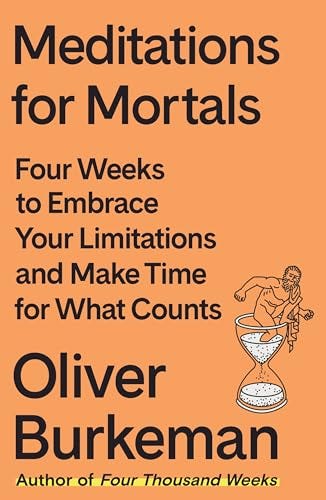
Meditations for Mortals is Oliver Burkeman’s follow-up to Four Thousand Weeks. Twenty-eight short chapters, one per day, for four weeks. Each chapter circles a single idea Burkeman calls imperfectionism: the recognition that you will never have time for everything, never be ready, never have the perfect conditions, and that this is not a problem to solve but the precondition for a real life.
He builds on Heidegger’s Geworfenheit, “thrownness”. The strange fact that you wake up inside a life you did not choose, with a personality you did not pick, and time flowing out from under you whether you notice it or not. The conclusion is not nihilistic. It is the opposite. If you cannot do everything, you may as well start now with the few things that count.
The line that stayed with me longest:
“Just doing something once today, just steering your kayak over the next few inches of water, is the only way you’ll ever become the kind of person who does that sort of thing on a regular basis. Otherwise you’re merely the kind of person who spends your life drawing up plans for how you’re going to become a different kind of person later on.” (Loc. 292)
That is the argument, in one sentence. The next few inches. Not the system. Not the routine. Not the version of yourself that will appear once the studio is finally organised.
Burkeman sits in good company on my shelf. Marcus Aurelius, whom I wrote about in December, is the older, sterner ancestor of this argument: you could leave life right now. Rick Rubin in The Creative Act makes the same case from inside the creative process. Trust the practice, not the plan. And David Lynch on meditation said it most simply: bait your hook and wait.
A serious recommendation. If you only read one book on time and finitude this year, read this one.
Irving Penn × Issey Miyake. Penn-san
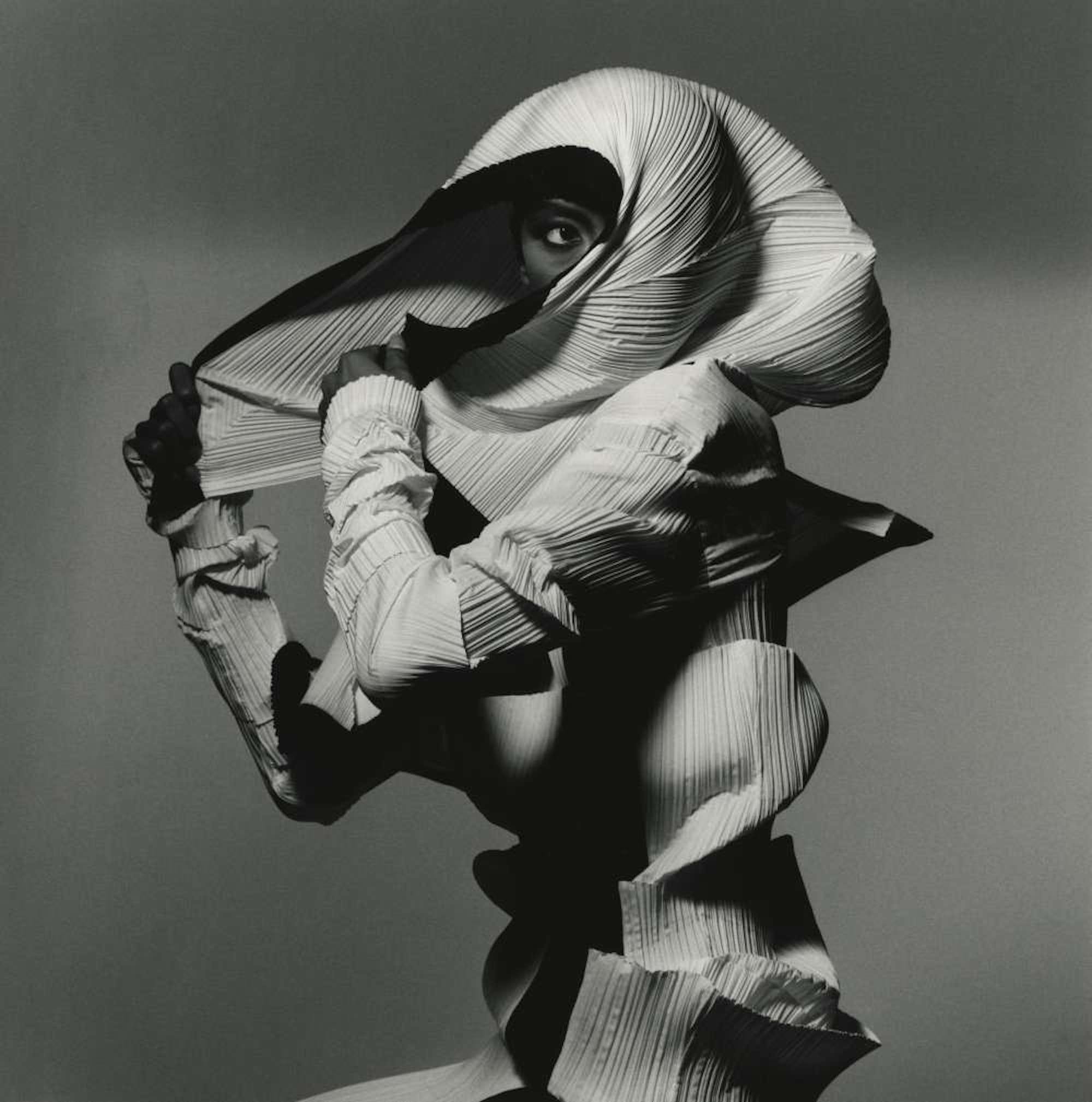
I came across a piece in Aperture this week about Irving Penn and Issey Miyake. Two names that sit on the very shortest list of people who have shaped how I see. Penn comes up in every interview I have ever given when someone asks who taught me to look in black and white. Miyake has been my favourite fashion designer since I started paying attention to clothes at all.
For more than two decades they made work together. Miyake called Penn Penn-san. They met in Tokyo over dinner, introduced by the publisher Nicholas Callaway. In 1986 Penn began shooting Miyake’s seasonal collections in New York, and here is the part that stopped me cold. Miyake insisted Penn be unhindered. He absented himself from the New York shoots. Penn would sit at a table with a pencil and paper, sketch as the models were directed, take Polaroids, then shoot. After each session, the transparencies flew to Tokyo, where Miyake used them as the springboard for his next collection.
That is the structure of a real creative dialogue. Not approval. Not art direction. Trust.
The first time Miyake saw what Penn had done with his clothes, a 1983 editorial for American Vogue, he said: “Wow! I never thought of looking at clothes in that way! The clothes have been given a voice of their own!” Years later, in the catalogue Irving Penn: A Career in Photography (1997), Miyake wrote that without Penn-san’s eye he could not have continued to find new themes to challenge himself. Penn’s images directly fed the invention of Pleats Please. Editor Mark Holborn put it best, in the photobook Irving Penn Regards the Work of Issey Miyake (1999): “the work of one provides a mirror for the work of the other.”
I wrote last week about why brands hire my eye, about being an artist first inside a fashion frame. Penn × Miyake is the Platonic ideal of that exchange. The designer who understands that an outside eye, given full freedom, can mirror back what you were already subconsciously trying to capture. That is not a service. That is a sounding board. Or, in Miyake’s own closing words: “One always needs someone who can look over one’s shoulder and evaluate one’s work from a detached and objective point of view, someone who can act as a sounding board.”
Elon Musk. The limit is mostly mental

A strange guest on this list, I know. But this month I listened to a Modern Wisdom episode, Eric Jorgenson on The Wild Psychology of Elon Musk, and I could not put it down.
Musk is controversial. I do not need to explain that. But for me he is also the genius of our time. And the part that lands hardest as an artist is how he thinks, not what he thinks.
After PayPal, Musk had roughly two hundred million dollars to spend. Instead of doing something safe, he decided that the space programme had to change. Better. Cheaper. More human in ambition. He almost started as a philanthropist. Not with a finished plan, but with a statement: I want to build a rocket. I want to learn how this works. I want to put a small plant on Mars.
What follows is the part I cannot let go of. Saturday sessions with rocket scientists. Back to first principles. Every assumption pulled apart. How can this be better? How can this be cheaper? SpaceX did not become an idea. It became a system. A movement. Proof that most limits are mental limits.
I do not work with rockets. I work with light and black and white. The lesson translates anyway. If you take a problem big enough and stay inside it long enough, you can rewrite the rules. Not by talking about possibilities, but by picking one problem and standing inside it.
That is the same engine Burkeman described a few paragraphs back, only at a different speed. Burkeman says do one thing today. Musk says do the one thing today that everyone says cannot be done. Both true. Both needed.
Not art. Inspiration. And sometimes that is enough.
What stays with me, looking at all four together, is one small thing. None of them tries to do the work alone. Salbitani makes room for the world. Burkeman makes room for time. Miyake made room for Penn-san for two decades. Musk makes room for a problem big enough to argue back.
A bigger room, in four different ways. That is what April taught me.
— Bastiaan